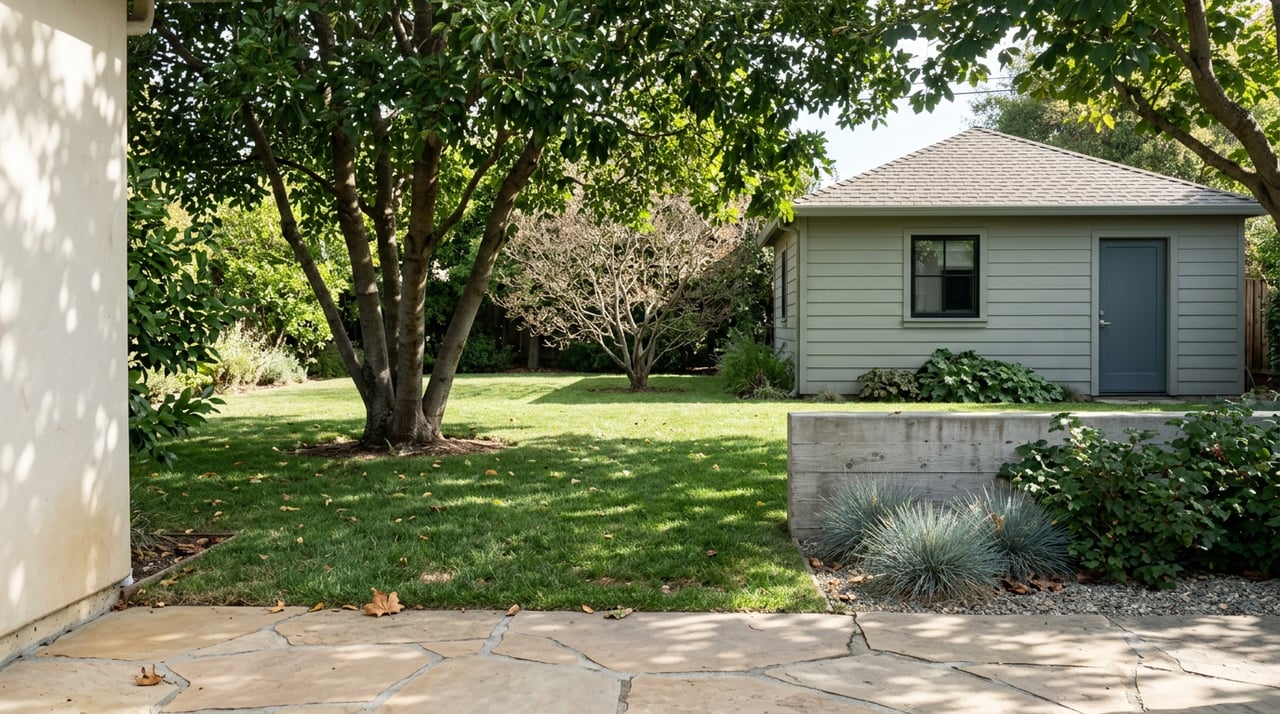
Drive south on Danville Boulevard and there is no sign, no gate, no shift in the pavement that tells you when Danville ends and Alamo begins. The oaks look the same. The lots get a little bigger. Somewhere around Livorna Road, you have crossed from a city into a place that has never had one.
That distinction sounds like trivia until the day you want to add a guest house, replace a failing septic system, or figure out who is responsible for the potholes on your own street. In Danville, you would call city hall. In Alamo, there is no city hall to call, and that single administrative fact reshapes what a big Alamo lot is actually worth compared to an equally large lot a few minutes away in an incorporated neighbor.
The Council That Advises but Can't Approve Anything
Alamo is unincorporated Contra Costa County. There is no Alamo planning department, no Alamo building inspector, no mayor. Land-use decisions run through the county's Department of Conservation and Development in Martinez, with applications filed at the counter at 30 Muir Road or through the county's ePermits portal.
The closest thing Alamo has to local representation is the Alamo Municipal Advisory Council, a nine-seat body formed in 2009 that meets the first Tuesday of every month at the Alamo Women's Club on Danville Boulevard. Its charge, in the county's own words, is to advise "on services that are or may be provided to the Alamo community" by the county or other agencies. It weighs in on land use, code enforcement, public works, and transportation. It does not issue permits. Dr. Michaela Straznickka chairs the 2026 council; at the July 7 meeting, Public Works Director Warren Lai presented an update on county infrastructure, and the August meeting was cancelled outright, a small, current reminder that Alamo's civic calendar runs on a volunteer advisory schedule, not a city council's.
A Real Lot Split Shows How the County Actually Decides
This isn't an abstract distinction. Earlier this year, the county's Board of Supervisors heard a rezoning and minor subdivision request to split a parcel at 1921 Green Valley Road in unincorporated Alamo into two lots for two single-family residences. That kind of decision, approving a tentative map, a tree permit, and a rezoning ordinance for a single Alamo property, goes to the county's Board of Supervisors, the same body that governs every unincorporated community in Contra Costa County, not to a town planning commission dedicated to Alamo alone. Every meaningful change to an Alamo property, from a lot split to an ADU, funnels through the same countywide machinery that, on the same kind of agenda, also handles agricultural preserve contracts out in unincorporated Byron.
The 2025 ADU Rewrite Nobody's Listing Sheet Mentions
Here is where the county's structure actually works in Alamo's favor, on paper. Contra Costa rewrote its accessory dwelling unit ordinance in May 2025, and the rewrite favors exactly the kind of lot Alamo is known for. The county's large-lot ADU allowance kicks in at 12,000 square feet. Alamo's R-20 zoning starts at 20,000 square feet, well above that threshold, so the allowance effectively applies to almost every conventionally zoned parcel in town. A detached ADU can run to 1,200 square feet, an attached garage of 600 to 800 square feet doesn't count against that cap, and the county dropped its old rule requiring an ADU to architecturally match the main house. Review is ministerial: meet the objective standards and the county has to approve it, with no design hearing and a 60-day state clock once an application is complete.
That is a genuinely favorable rule set. It is also only half the story, because the county's paperwork isn't the thing that actually decides whether you can build.
Septic or Sewer Decides the Real Budget
The land itself asks the harder question, and it comes down to whether a lot sits on public sewer or a private septic system.
| On public sewer | On a septic system | |
|---|---|---|
| Who signs off | Central Contra Costa Sanitary District | Contra Costa Environmental Health |
| What it typically costs | Central San's ADU capacity fee: $3.63 per square foot, capped at 1,200 square feet, under $3,000 for an 800-square-foot unit | A per-site engineering review of whether the existing system can absorb the added load |
| If capacity is the problem | Not usually an issue on an already-sewered lot | Upgrade the septic system, or connect to sewer through Central San's Septic-to-Sewer financing (up to $65,000), plus roughly $9,200 to $10,200 in Central San connection fees for a new sewer customer |
For comparison, Central San charges a new single-family house $8,539 in ADU capacity fees against that same $3.63-per-square-foot schedule, so a sewered lot's ADU fee is genuinely modest. A septic lot's path depends entirely on whether the existing system has room, a question no listing sheet answers and no county fee schedule can predict without a site visit from Contra Costa Environmental Health.
Two more line items compound the difference. East Bay Municipal Utility District charges roughly $19,500 to establish a new water meter, a cost an ADU avoids only by running off the house's existing meter. And San Ramon Valley Unified School District collects its own developer fee on any ADU over 500 square feet, at $5.17 per square foot. Neither of these appears on a Zillow estimate. Both appear on the actual permit invoice.
The Hillside Edge Adds a Fire District Into the Mix
Fire review for Alamo construction comes from the San Ramon Valley Fire Protection District, and the state's 2025 fire-hazard-severity maps place parts of that district's territory, including Alamo's hillside edges toward Las Trampas and the Diablo foothills, in elevated severity zones. A parcel that lands in one of those zones picks up ignition-resistant construction standards and defensible-space requirements that the fire district signs off on before final inspection. A flat Alamo lot near Livorna Park and a hillside Alamo lot toward the Diablo foothills can face genuinely different construction requirements, even though both carry the same Alamo address and the same county jurisdiction.
HOA Country, but the HOA Can't Say No to the ADU
Alamo is dense with homeowners associations left over from mid-century subdivisions, and CC&Rs here run deep. State law overrides them on this specific point: it voids CC&R provisions that prohibit or unreasonably restrict ADUs and bars HOAs from attaching fees or financial conditions to one. An association can offer reasonable, cost-neutral design input. It cannot veto the unit outright.
The same unincorporated structure shows up on the streets themselves. Plenty of Alamo's larger, more secluded lots sit on private roads, and California Civil Code Section 845 puts maintenance responsibility on the property owners who use the road, splitting costs proportionately to use in the absence of a formal agreement. Where no road maintenance association exists, and many don't, a pothole dispute becomes a conversation between neighbors, sometimes settled in small claims court, rather than a call to a city street department.
What This Changes About Comparing Alamo to Danville or San Ramon
None of this shows up in a median price or a price-per-square-foot figure. It shows up the first time a buyer tries to act on the lot size that drew them to Alamo in the first place. Before treating an Alamo comparison to Danville or San Ramon as a straightforward price-per-acre exercise, it's worth running through five questions specific to how Alamo actually functions:
- Is the parcel on public sewer or a septic system, and if septic, has anyone evaluated whether it can absorb additional load?
- Which water purveyor serves the lot, and what would a new meter or capacity charge look like if one is needed?
- Does the parcel fall inside one of the elevated fire-hazard-severity zones toward Las Trampas or the Diablo foothills?
- Is there an active HOA, and do its CC&Rs reflect current state ADU law or an older version that no longer applies?
- If the lot fronts a private road, is there a functioning maintenance association, or does upkeep default to Civil Code Section 845?
A big lot in Alamo is still a big lot. Whether it can support the guest house, the multigenerational suite, or the rental unit that made the price feel worth it depends on land-use machinery that behaves nothing like the city departments next door.
FAQ
Does the county's 2025 ADU ordinance apply to older Alamo homes, or only new construction? It applies to existing properties. The process is ministerial and tied to objective standards like lot size and setbacks, not to when the main house was originally built.
Can a septic system disqualify a lot from adding an ADU? Not automatically, but it is the first question to resolve, not the last. Contra Costa Environmental Health has to approve the arrangement before the ADU can be established, and that approval depends on a per-site engineering read of the existing system's capacity.
Should I contact the county or the Alamo Municipal Advisory Council about a permit? The county. The MAC advises on policy and community concerns but has no authority over individual permits. Planning and building applications go through Contra Costa County's Department of Conservation and Development.
Can an Alamo HOA block or add fees to an ADU? No. State law voids CC&R provisions that prohibit or unreasonably restrict accessory dwelling units and bars HOAs from charging fees tied to them, though an association can still offer reasonable, cost-neutral design input.
If you're weighing an Alamo property against something in Danville or San Ramon and want to know what a specific parcel's septic status, fire zone, or HOA covenant actually means for your plans, that is exactly the kind of due diligence Cynthia Money and The Money Group handle before you write an offer. Request Your Personalized Consultation and get a clear read on what a property can actually support, not just what its lot size suggests.